IROS 2026

BOWConnect: Parallel Bayesian Optimization over Windows with Learned Local Cost Maps for Sample-Efficient Kinodynamic Motion Planning

A bidirectional parallel kinodynamic planner achieving 100% success rate with real-time computation across ten benchmark environments, validated on ground and aerial vehicles.

Author Name1Author Name1Author Name1

1 Your Institution

Paper arXiv Video Code
Overview

Abstract

This paper presents BOWConnect, a bidirectional parallel kinodynamic motion planner that addresses three fundamental limitations of existing sampling-based methods: sample inefficiency in high-dimensional state spaces, unreliable cost heuristics under dynamic constraints, and poor performance in narrow passage environments.

Unlike classical planners that rely on random control sampling and geometric distance heuristics, BOWConnect integrates Bayesian Optimization over Windows (BOW) as a learning-based steering function within a parallel tree-based exploration framework, enabling each worker to learn local cost maps and constraints to guide sampling toward dynamically feasible and collision-free controls.

A bidirectional architecture simultaneously grows forward and backward trees from the start and goal regions in parallel threads, with a spatial hashing mechanism enabling fast connection queries and a boundary value problem solver generating kinodynamically consistent bridge trajectories.

Extensive evaluations across ten benchmark environments demonstrate that BOWConnect achieves 100% success while achieving the fastest or near-fastest planning time, including narrow passages and non-convex spaces where state-of-the-art planners fail, with real-world deployment on a ground vehicle and a quadrotor confirming real-time planning with no collisions.

Highlights

Key Contributions

01

Online Learning-Based Steering

Generates collision-free, kinodynamically feasible trajectories directly in continuous state and control spaces using GP-guided Bayesian Optimization.

02

Bidirectional Parallel Architecture

Simultaneously grows forward and backward trees from start and goal in parallel threads, enhancing global connectivity.

03

Spatial Hashing Mechanism

O(1) lookup within the MotionTree data structure for efficient multi-stage feasibility verification and fast connection queries.

04

Real-World Validation

Validated on ground vehicles (unicycle & bicycle) and quadrotors with planning under 0.15s and zero collisions.

Approach

Method Overview

BOWConnect spawns N/2 forward workers and N/2 backward workers, each maintaining its own search tree and BOW instance. Each worker grows its MotionTree using constrained Bayesian Optimization — sampling controls, simulating dynamics via 4th-order Runge-Kutta, and learning separate GP models for reward and constraint.

When a potential connection between trees is detected via spatial hashing, multi-stage verification checks kinematic feasibility before solving a boundary value problem to generate the connecting trajectory.
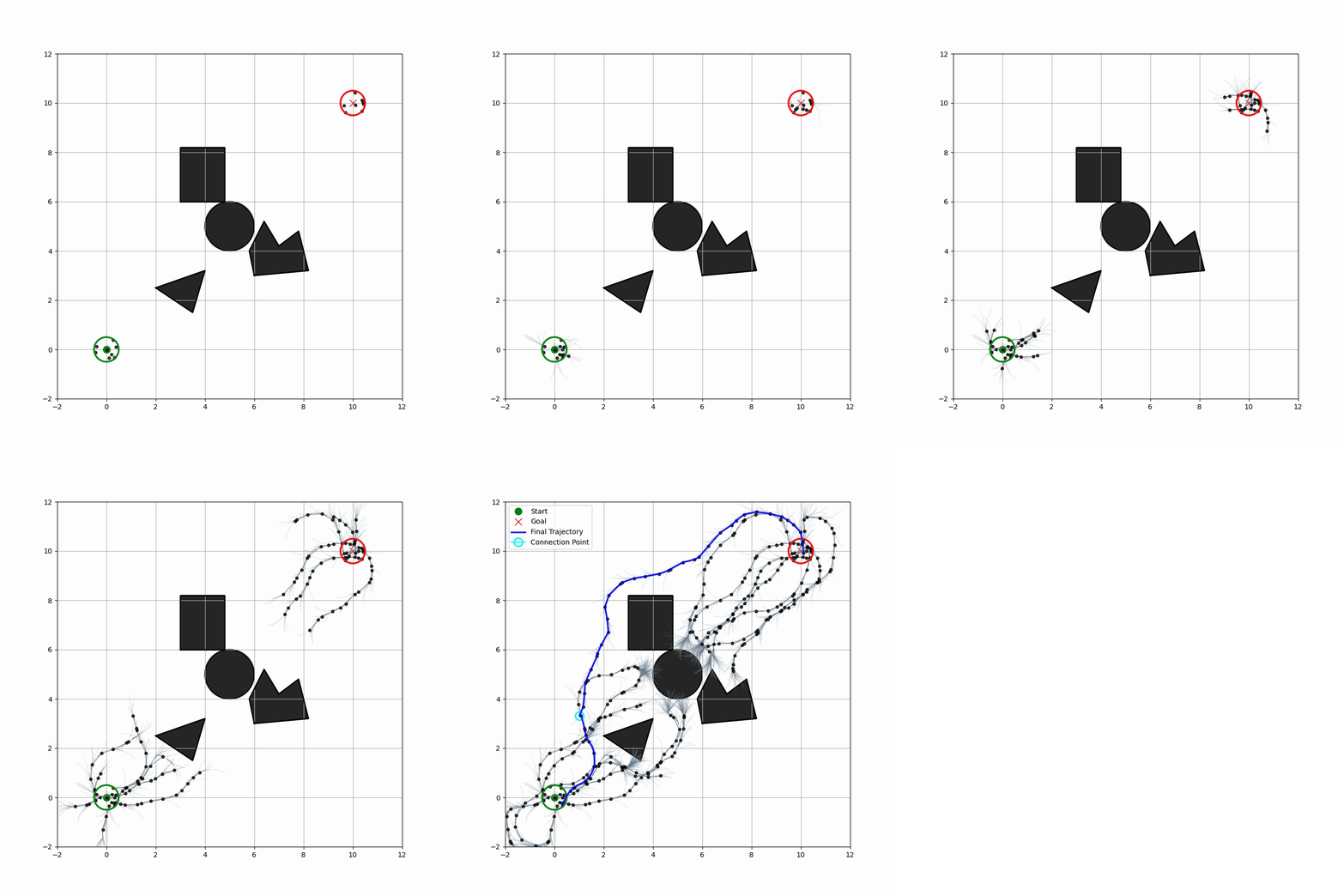
Parallel motion tree growth of BOWConnect
Figure 1. Parallel motion tree growth in a cluttered planar environment. Trees grow from start (green) and goal (red) regions. Grey trajectories show sampled short-horizon paths; bold blue curve is the final connected path. Cyan highlights the BVP connection.
System Architecture
Start Region
Sample states S
Forward Workers
BOW + MotionTree
Spatial Hash
Connection detection
Backward Workers
BOW + MotionTree
Goal Region
Sample states G
BVP Solver
Bridge trajectory
Merged Trajectory
Feasible path

Key Formulations

r(u) = −‖p(T) − ptarget‖ if collision-free, −∞ otherwise(6)
c(u) = 1 − 𝕀collision(τ(u))(7)
α(u) = [μr(u) − κσr(u)] × Pfeas(u)(8)
Evaluation

Benchmark Results

100%
Success rate
10
Environments
<0.15s
Real Time Planning
0
Real-world collisions
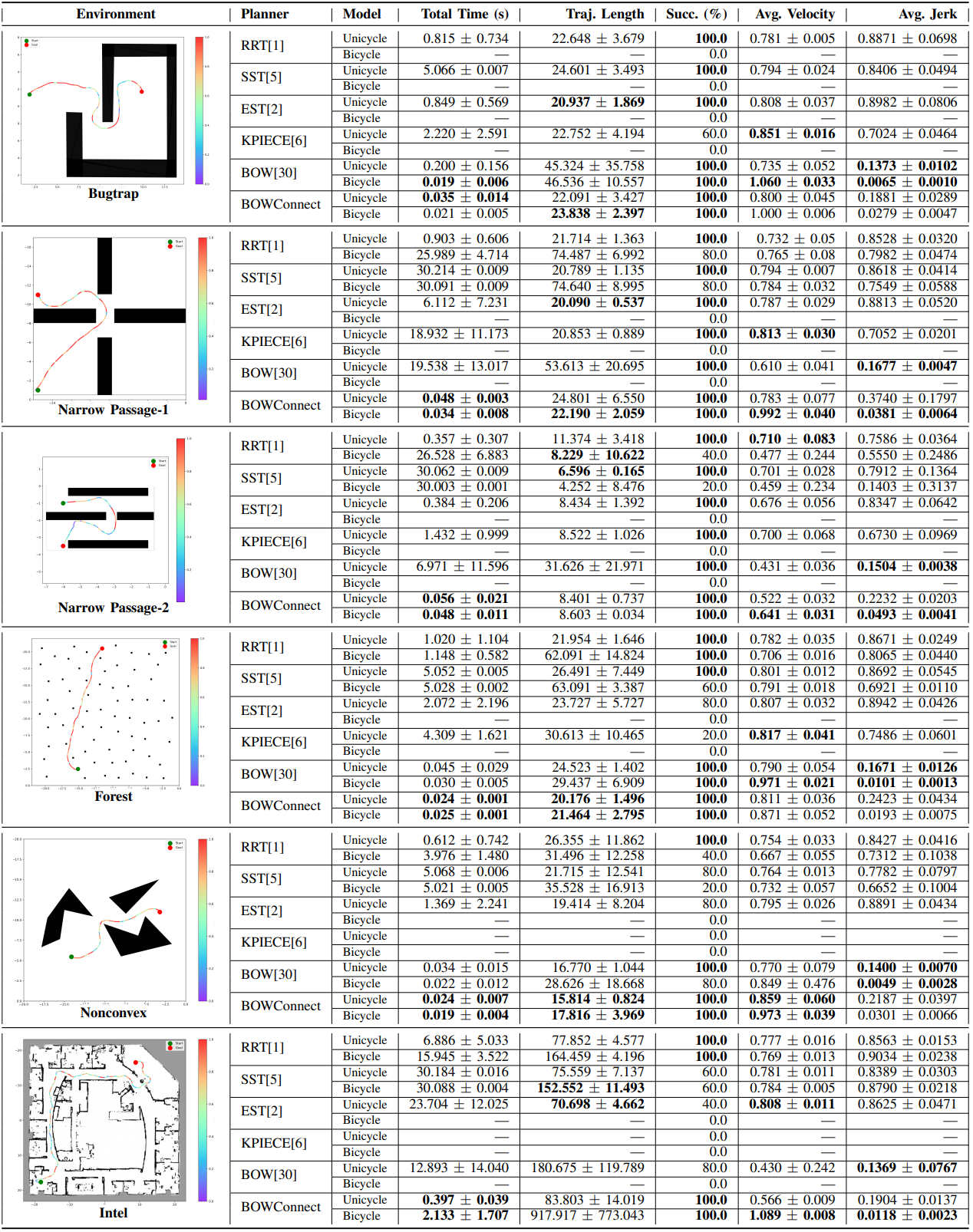
Table I: UGV Benchmark Results
Table I. Comparison of kinodynamic motion planning methods across six UGV environments. Best results highlighted in bold. A dash (—) denotes planner failure.
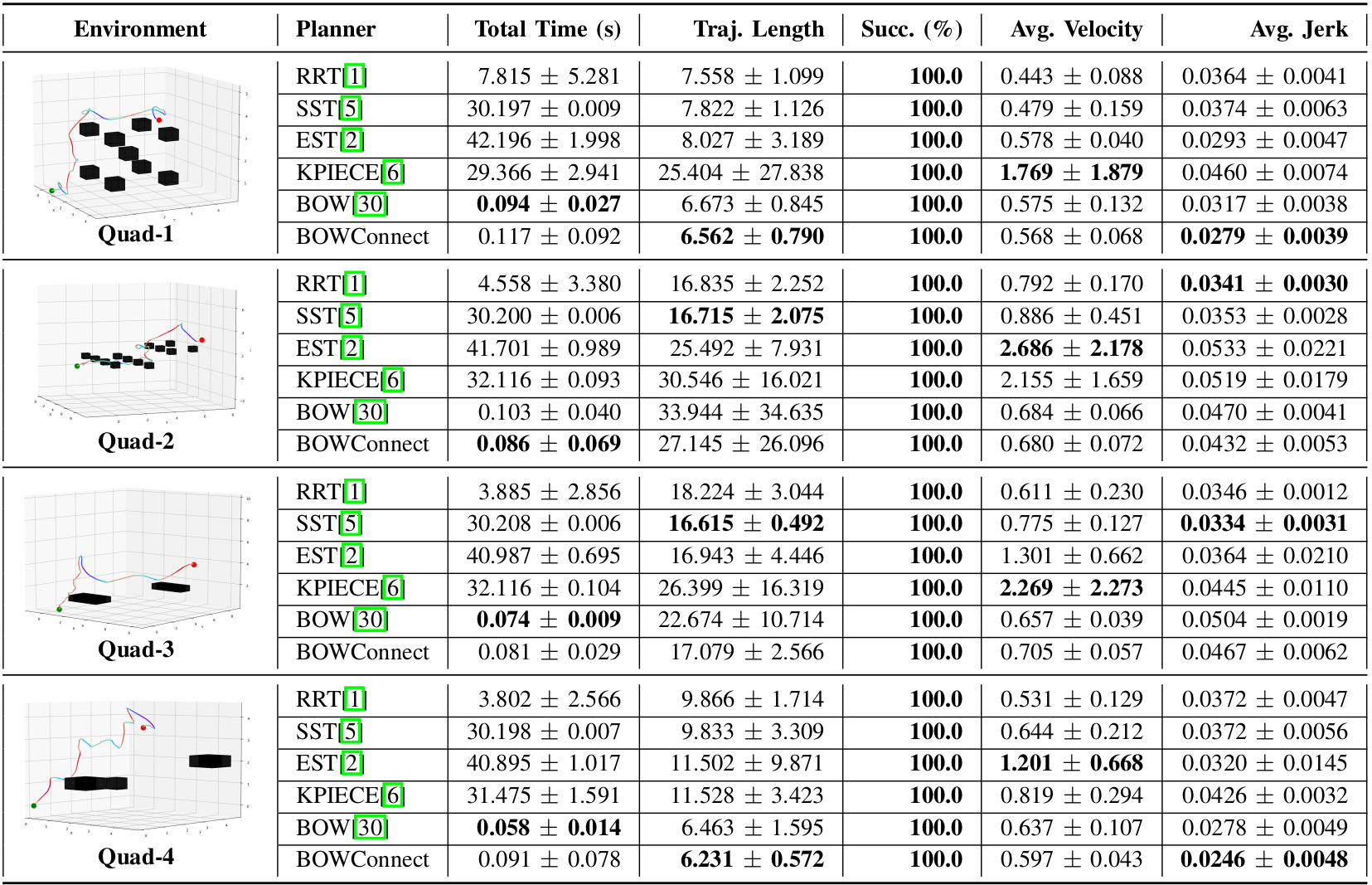
Table II: UAV Benchmark Results
Table II. Comparison across four quadrotor environments. All planners evaluated using a quadrotor dynamic model.
Demonstrations

Videos

UGV Exploration

Ground vehicle navigating cluttered indoor environments

Ground Vehicle

UAV Exploration

Quadrotor navigating 3D environments with real-time obstacle avoidance

Aerial Vehicle
Real-World

Physical Experiments

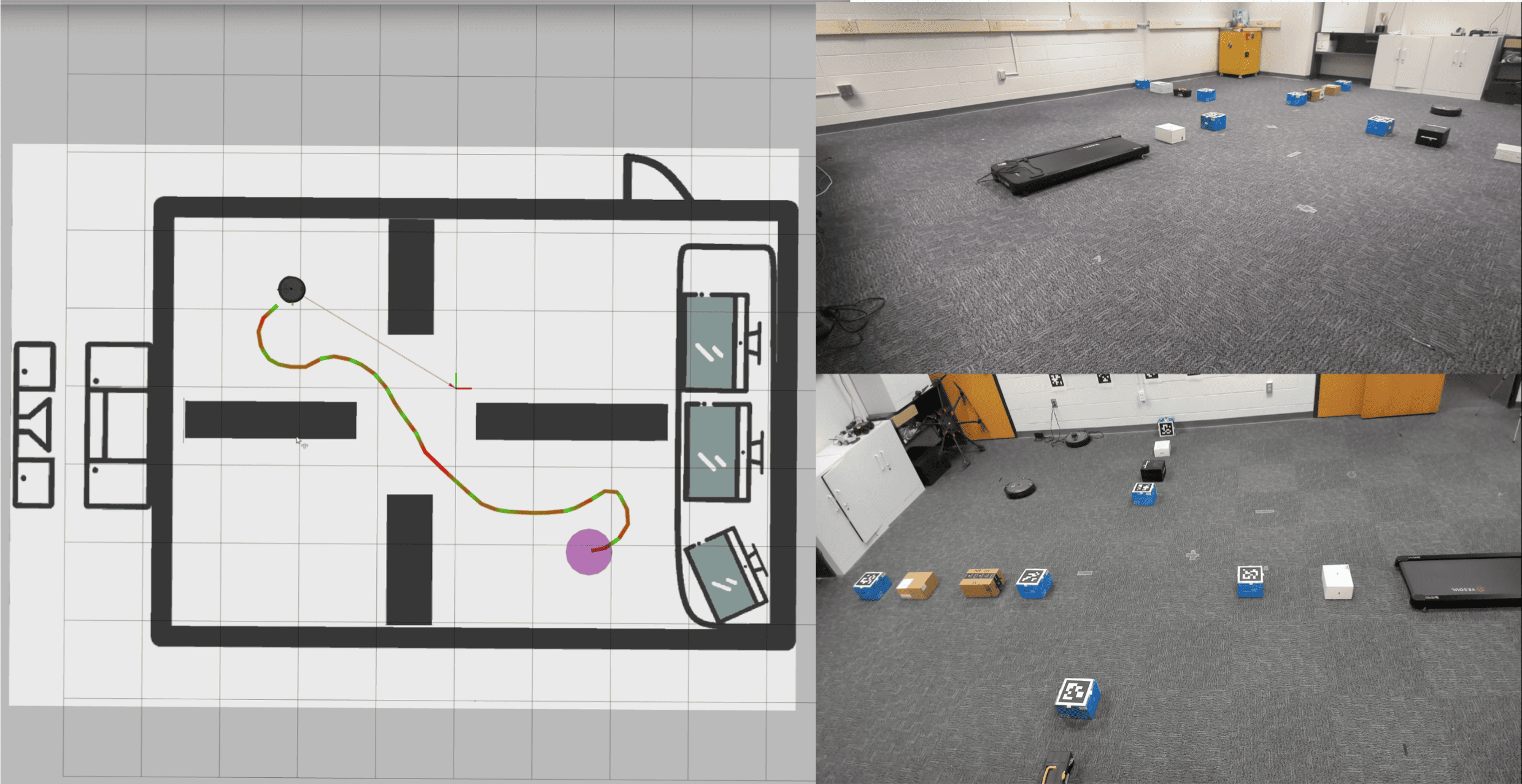
UGV experiment configuration A
Ground Vehicle

UGV — Configuration A

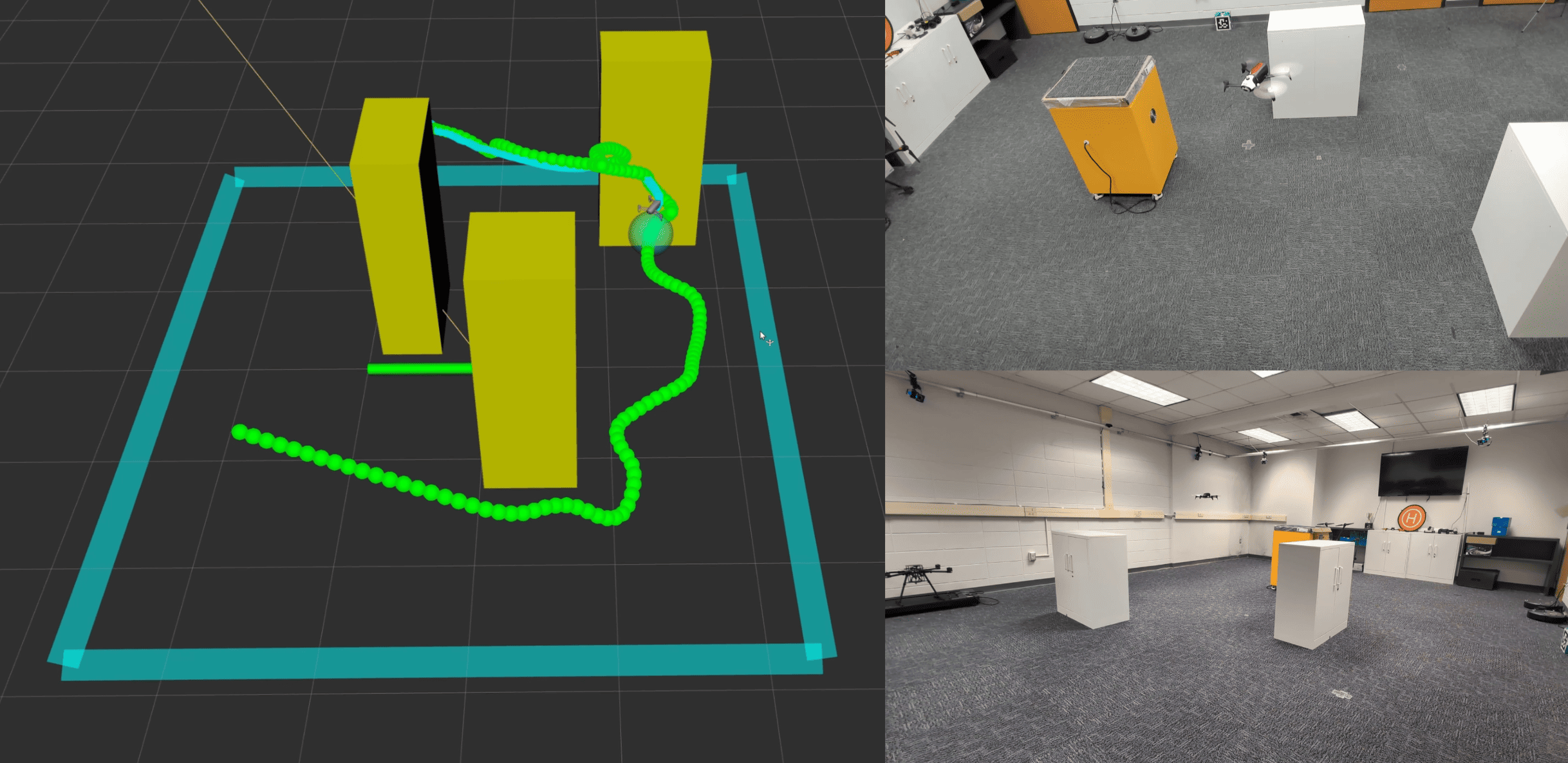
Create 3 robot in 6.5m × 5.5m workspace. Left: RViz trajectory. Right: real-world execution. No collisions.

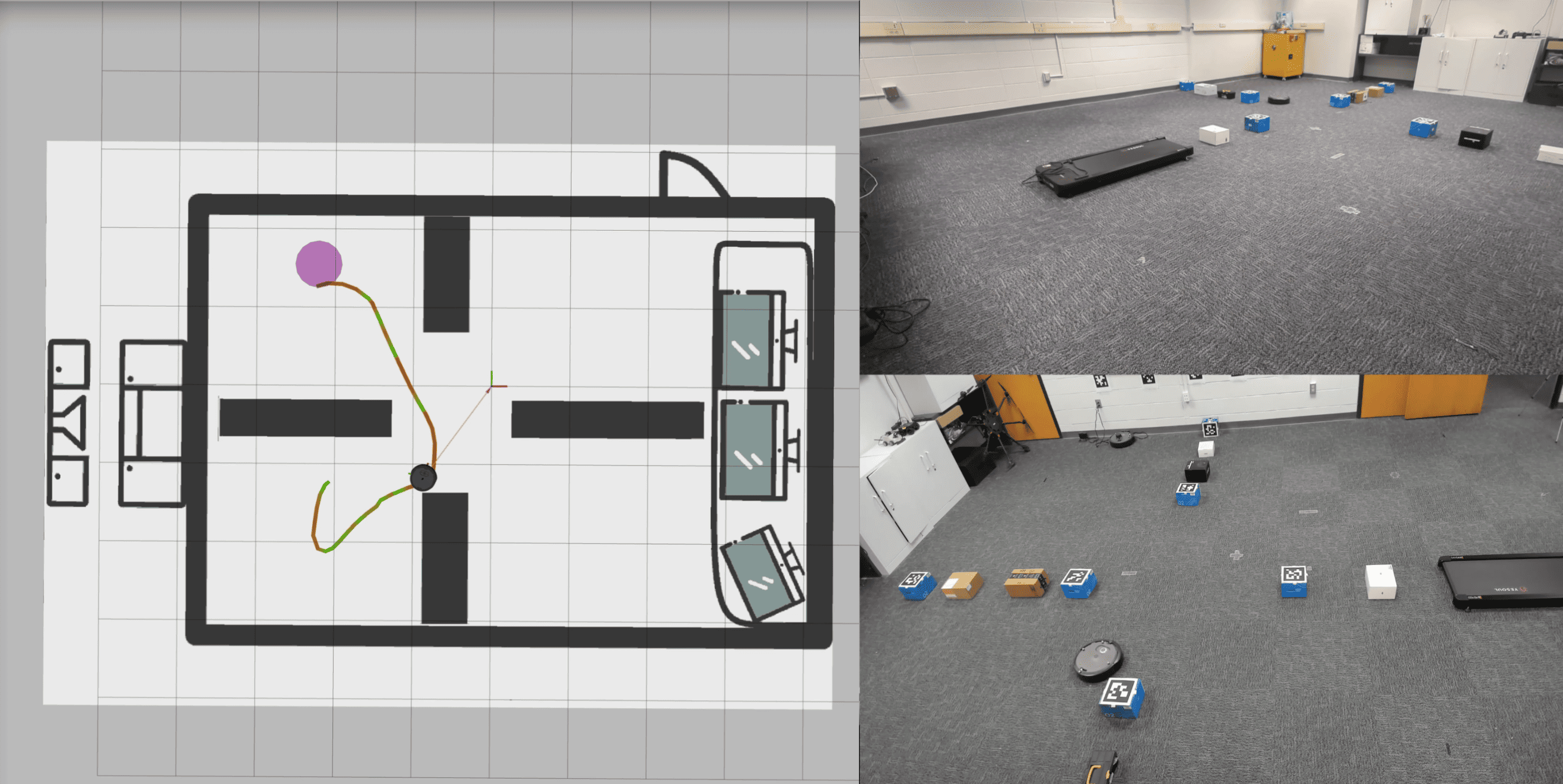
UGV experiment configuration B
Ground Vehicle

UGV — Configuration B

Second start–goal configuration. Average planning time 0.12s, max 0.15s across all runs.

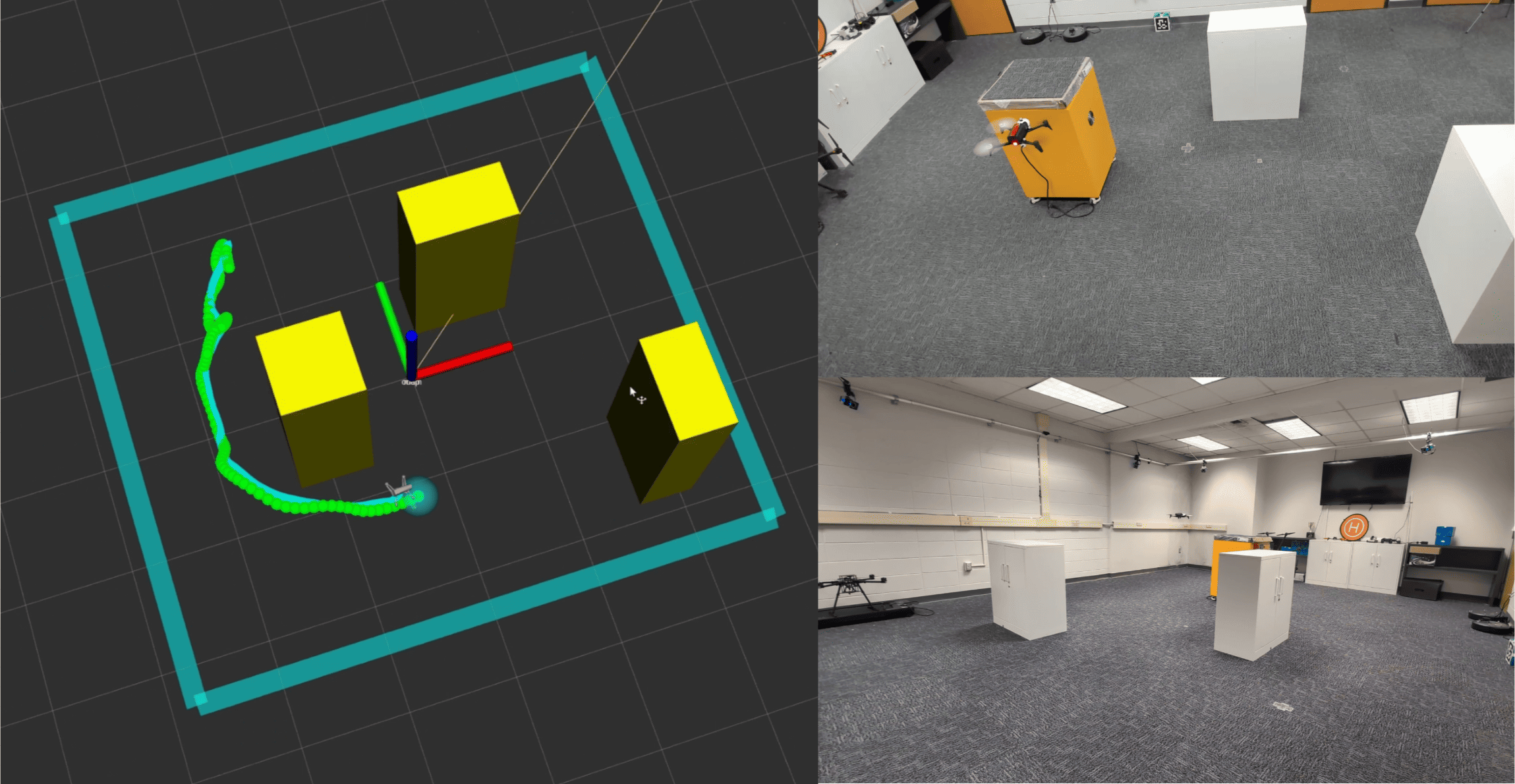
UAV experiment configuration A
Aerial Vehicle

Quadrotor — Configuration A

Parrot Bebop 2, 8D state, 6.5m × 5.5m × 2.5m workspace. Close sim-to-real alignment.

UAV experiment configuration B
Aerial Vehicle

Quadrotor — Configuration B

Collision-free trajectories under 0.1s. Real-time high-dimensional planning confirmed.

Citation

BibTeX

bowconnect2026.bib
@inproceedings{bowconnect2026, author = {Author Names}, title = {BOWConnect: Parallel Bayesian Optimization over Windows with Learned Local Cost Maps for Sample-Efficient Kinodynamic Motion Planning}, booktitle = {IEEE/RSJ International Conference on Intelligent Robots and Systems (IROS)}, year = {2026}, }